Blog ·
What was the first video game?
The game most often called the first video game is Tennis for Two, which physicist William Higinbotham showed at Brookhaven National Laboratory on Oct 18, 1958. But the honest answer depends on what you count as a video game: a 1947 patent describes an earlier screen game with no computer at all, Spacewar! (1962) was the first to spread from computer to computer, and Pong and the Magnavox Odyssey (both 1972) were the first that ordinary people could buy or put a coin in.
Here are the main contenders, in order.
| Year | Game | Made by | Why it counts |
|---|---|---|---|
| 1947 | Cathode-ray tube amusement device | Thomas T. Goldsmith Jr. and Estle Ray Mann | The earliest patent for a game played on a screen |
| 1958 | Tennis for Two | William Higinbotham, Brookhaven National Laboratory | An interactive game on an electronic display that the public lined up to play |
| 1962 | Spacewar! | Steve Russell and friends at MIT | Ran on a computer, and its code spread to other machines |
| 1972 | Magnavox Odyssey | Ralph Baer at Sanders Associates, sold by Magnavox | The first home video game console |
| 1972 | Pong | Al Alcorn at Atari | The coin-op hit that started the arcade business |
What was the cathode-ray tube amusement device?
It was a game on paper before it was anything else. The patent, US 2,455,992 on Google Patents, was filed on Jan 25, 1947 by Thomas T. Goldsmith Jr. and Estle Ray Mann, assigned to Allen B. Du Mont Laboratories, and granted on Dec 14, 1948. It describes a player turning controls to steer the dot of a cathode-ray tube (the same kind of tube as an old television) toward targets placed on the face of the tube (its example is drawings of airplanes), with a visible explosion when a target is hit.
There was no computer and no image drawn by the machine: the targets were laid over the glass. That is why most histories call it a forerunner rather than the first video game.
What was Tennis for Two?
Tennis for Two is the game Brookhaven National Laboratory itself calls "unquestionably a forerunner of the modern video game" on its history page, The First Video Game?. Higinbotham, head of the lab's Instrumentation Division, built it for one of the lab's annual visitors' days, where it was first shown on Oct 18, 1958. In his words, quoted by the lab, "it might liven up the place to have a game that people could play."
The same page explains how it worked:
- The screen was an oscilloscope, showing a tennis court from the side, with the ball as a bright moving dot that left a trail as it bounced over the net.
- The brain was a small analog computer. Its instruction book showed how to draw the path of a bouncing ball on an oscilloscope, which is what gave Higinbotham the idea.
- The controls were two boxes, one for each player, each with a button and a dial that set the angle of an invisible racquet.
Hundreds of visitors lined up to play it. The lab also tells what happened next: in October 1982, Creative Computing magazine credited Higinbotham as the inventor of the video game, "until they heard from someone who could document an earlier game." That is the trouble with the question: there is almost always an earlier experiment somewhere.
Why do some people say Spacewar! was the first?
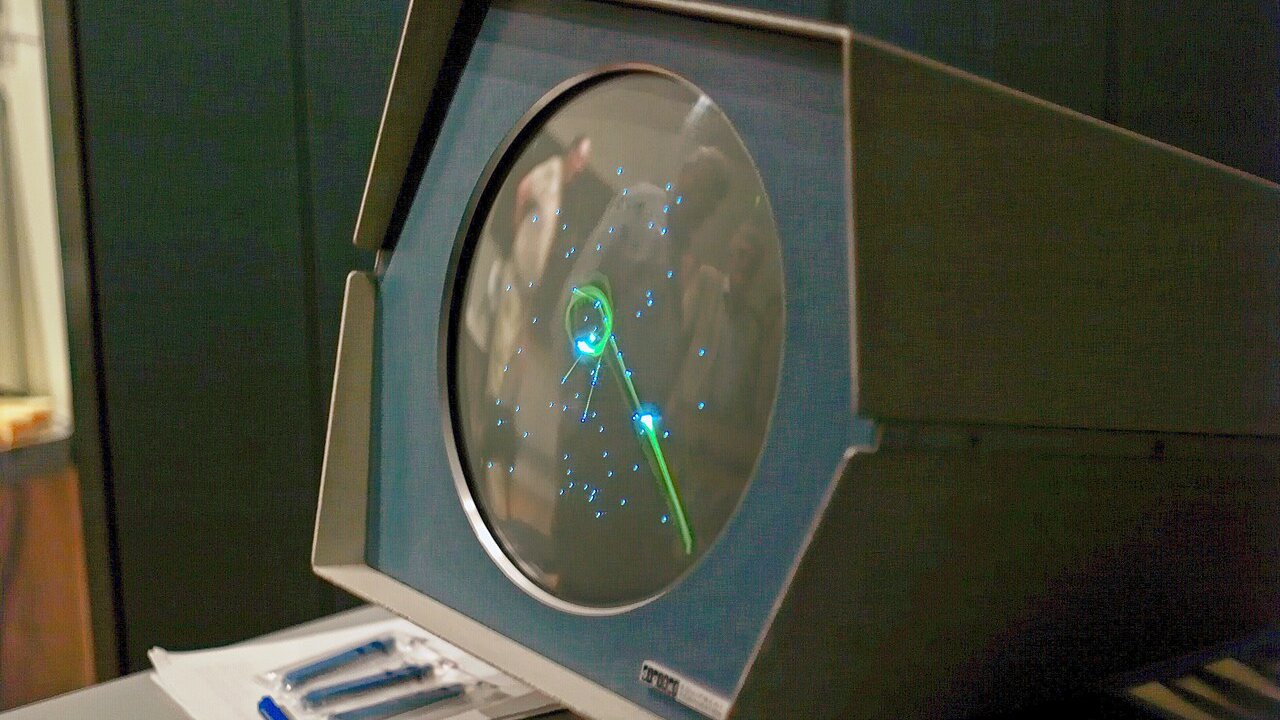
Because it was a program for a digital computer that people copied and carried to other machines, which made it the first video game to spread widely. The Computer History Museum's Spacewar! page says it was conceived in 1961 by Steve Russell, Martin Graetz and Wayne Wiitanen, inspired by E. E. "Doc" Smith's Lensman novels. Russell wrote the first version on the PDP-1, a computer made by Digital Equipment Corporation (DEC), and Peter Samson, Dan Edwards and Martin Graetz improved it in the spring of 1962.
Two players each fly a spaceship and try to shoot the other. The museum notes that the game needed more than 100,000 calculations a second for the ships, gravity and stars, and that DEC used it to show customers what the small machine could do. Smithsonian magazine's account adds the details that made it a real game: Samson's star field taken from the actual night sky, the pull of a star in the middle of the screen added by Dan Edwards, and a risky "hyperspace" escape. The team gave the code to DEC, it came loaded on PDP-1s installed after that, and students at other universities adapted it for their own computers.
You can still play it. Norbert Landsteiner's Spacewar! emulator runs the original PDP-1 code in a browser, with two players on one keyboard or a pair of gamepads (our post on playing browser games with a controller explains how that works). Our Spacewar! page has more on the game.
What was the first video game you could buy?
The Magnavox Odyssey, a console for the home television. Smithsonian magazine's obituary of Ralph Baer tells the story: in 1966 Baer, an engineer at the defense contractor Sanders Associates, had the idea of letting people play games on their own televisions. After five years of prototypes, his team filed a patent in March 1971 and, in the summer of 1972, licensed the system to Magnavox, which sold it as the Odyssey. It sold 130,000 units in its first year. Baer's prototype, the "brown box", is in the Smithsonian's collection.
And what about Pong?
Pong was the first video game hit in public places. The Computer History Museum's 50 Years of Fun With Pong says it was the first project of a new company, Atari, founded by Nolan Bushnell, Ted Dabney and Al Alcorn. Alcorn built the 1972 prototype from analog circuits and a cheap black-and-white television, in a wooden cabinet with two knobs and a coin box. Placed at Andy Capp's Tavern in Sunnyvale, California, it stopped working within days, and Alcorn found the reason: it was so full of quarters that it could not take any more.
The museum also notes that the Odyssey "probably inspired" Bushnell to make Pong. A home version followed, and Sears ordered 200,000 units for Christmas 1975. Our Pong page and our 1970s page gather the arcade classics that came after it.
So which one was really first?
It depends on the line you draw:
- First game on a screen, at least on paper: the cathode-ray tube amusement device, patented in 1948.
- First interactive video game the public played: Tennis for Two, 1958.
- First video game that spread as software: Spacewar!, 1962.
- First home console: the Magnavox Odyssey, 1972.
- First arcade hit: Pong, 1972.
If you want one name, Tennis for Two is the usual answer, and Brookhaven, which built it, still frames it as a question. What is not in doubt is the order: an engineer's patent, a physicist's open house, a group of MIT students, and then a bar in Sunnyvale. Our browse page gathers the classics that followed them, and the games they inspired.
More from the blog
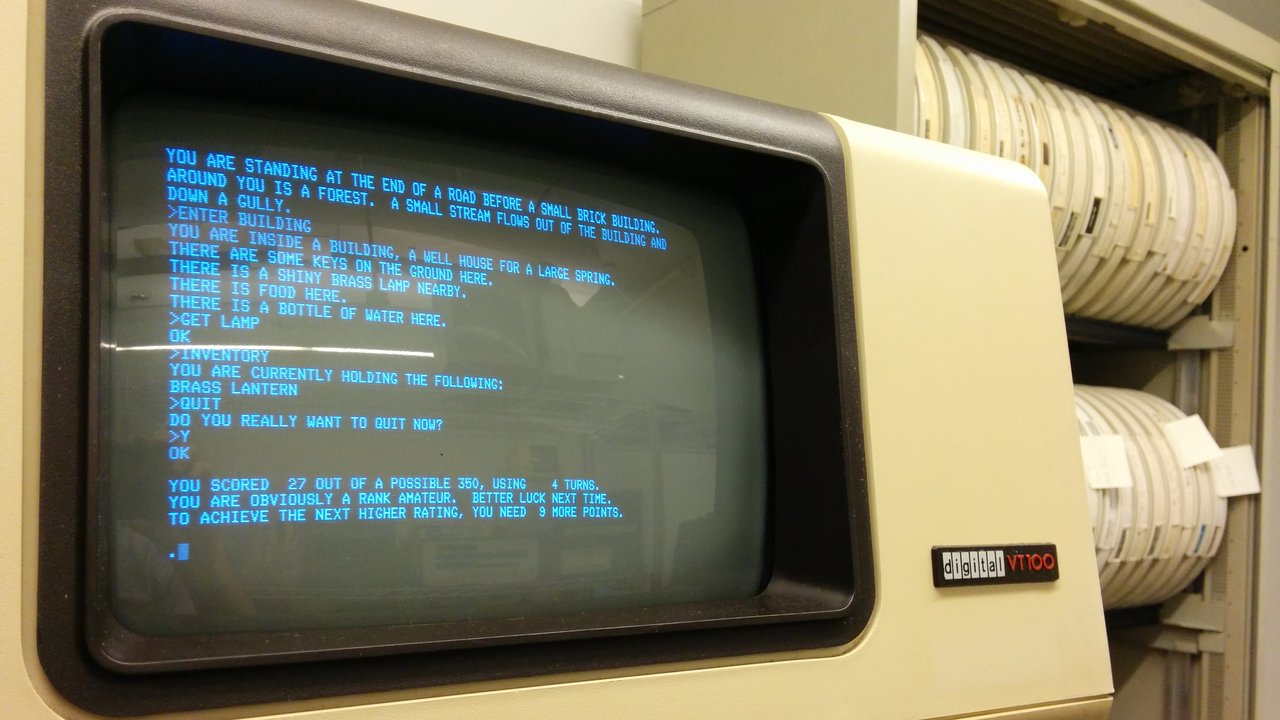 What was the first text adventure game?Colossal Cave Adventure, written by Will Crowther around 1975 and expanded by Don Woods in 1977, is the game that started the text adventure. Wander (1974) may be older. Here is how the first text adventures fit together, from the cave to Zork and Adventureland.
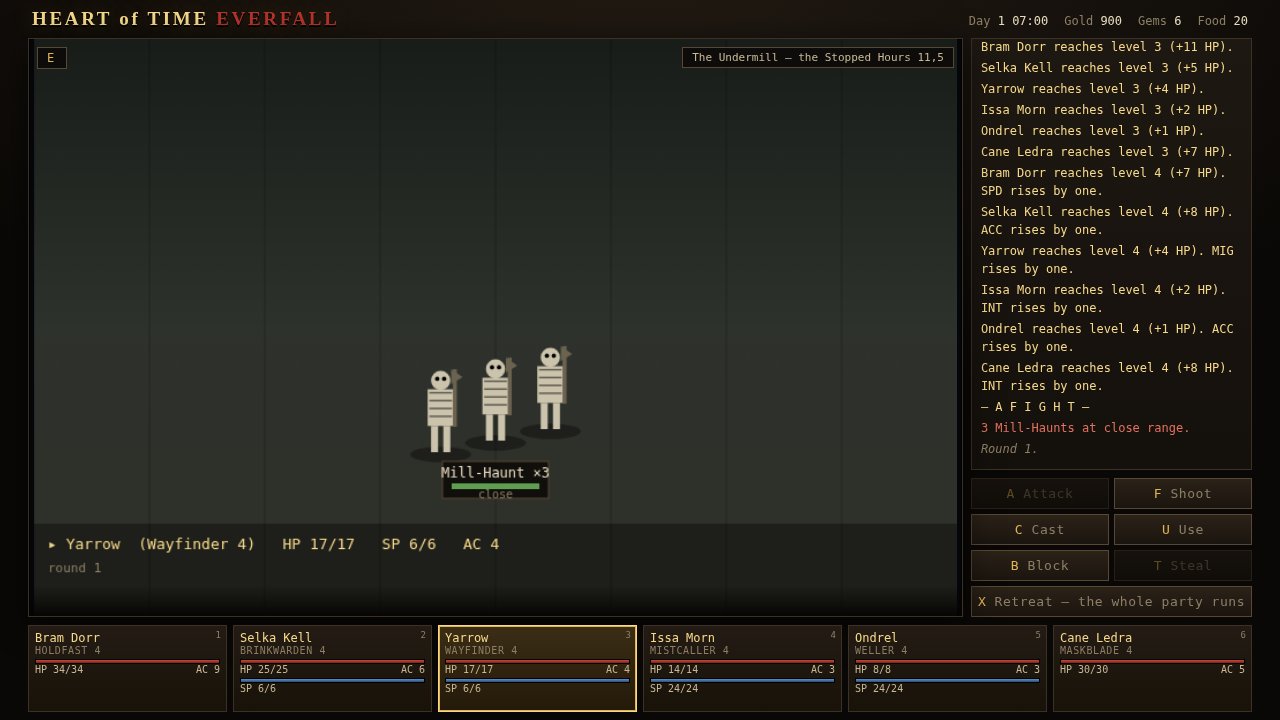 What was the first JRPG?The Dragon & Princess, made by Koei for the PC-88 in 1982, is the game most often named as the first Japanese role-playing game. The Black Onyx (1984) was the first popular one, and Dragon Quest (1986) made the genre a household name. Here is how they fit together.
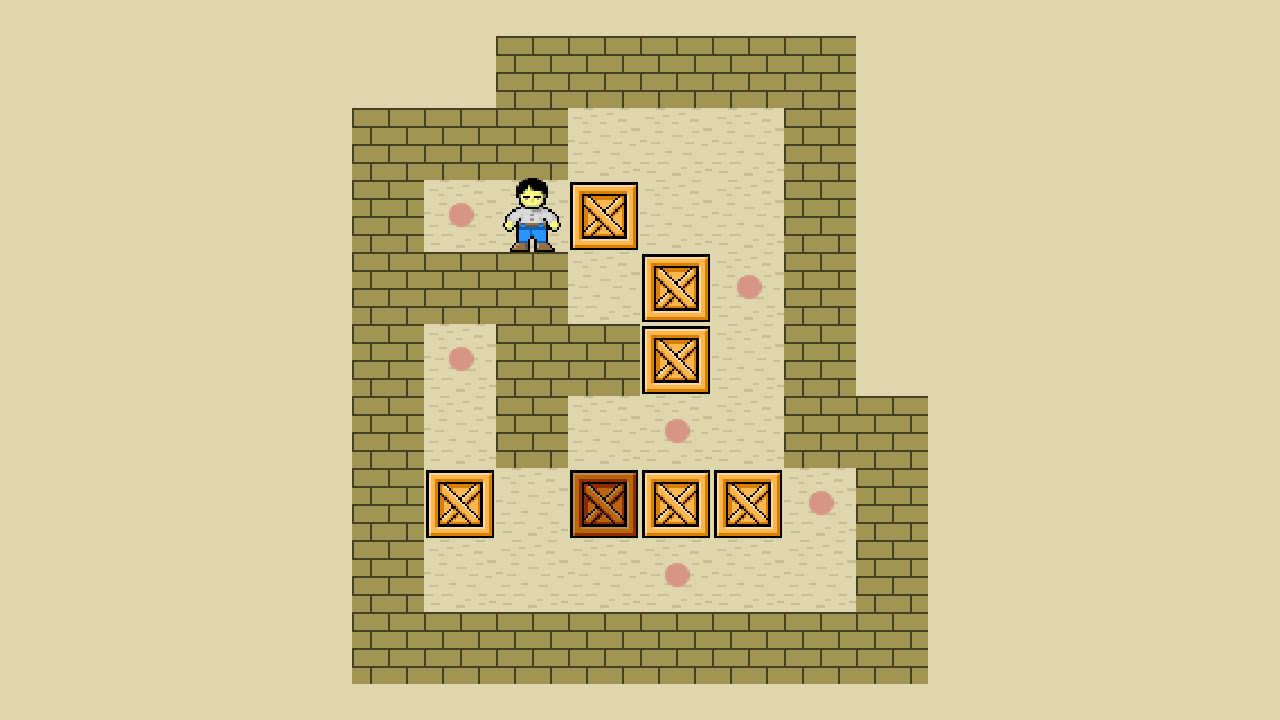 What is Sokoban?Sokoban is a 1982 box-pushing puzzle game by Hiroyuki Imabayashi of Thinking Rabbit, in which a warehouse worker pushes crates onto marked spots. Here are its three rules, who made it, why it is so hard, and games like it.