Blog ·
What was the first dot-eating maze game?
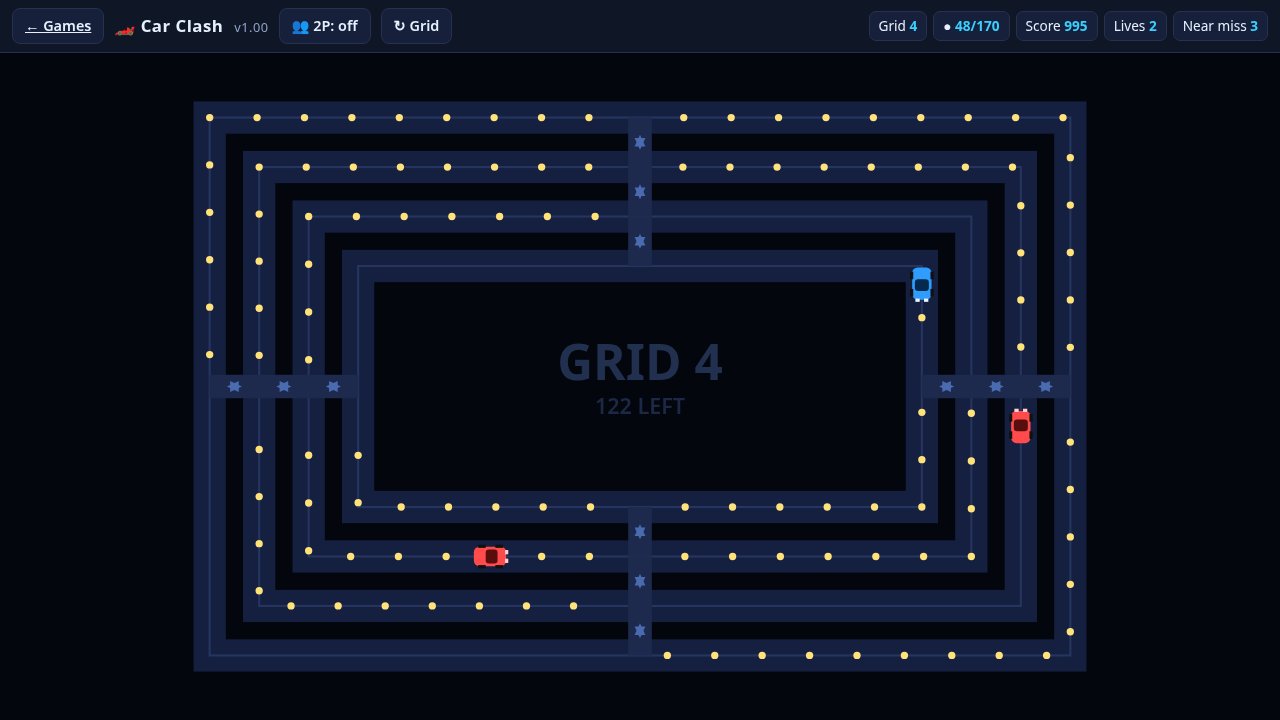
The first dot-eating maze game is generally held to be Head On, a 1979 arcade game designed by Lane Hauck at Gremlin and released by Sega. You drive a car around fixed lanes, clearing dots from them, while a computer car comes the other way. It reached Japanese arcades in April 1979, about 13 months before Pac-Man's Japanese launch on May 22, 1980.
Its designer made the claim himself early on. In a 1982 San Diego Reader profile, Hauck described the dots in its lanes and said, "This was the world's first dot-eating-up game!" Later histories mostly agree: Wikipedia's article on maze games calls Head On the progenitor of Japan's dot-eating games.
Note what the title does not claim. Head On was not the first maze game. Wikipedia names Atari's Gotcha (1973) as the first maze arcade game, and that one had no dots to clear. What Head On added was the goal of sweeping the whole maze clean.
How did Head On play?
The rules fit in a few lines, as Wikipedia's summary of the game sets out:
- Your car runs without stopping around rectangular channels, one inside another.
- Gaps at the four compass points are the only places you can change lanes.
- You must collect every dot on the screen.
- A computer-controlled car drives the opposite way, and a collision costs you a life.
Hauck told the Reader the idea came from lanes you are committed to once you enter them. That is the whole tension of the game: you can see the crash coming from across the screen, and you may still be half a lap from the next gap.
Why was it not a two-player game?
It was meant to be. Hauck's first design put two players in the lanes, and it failed for a reason any arcade owner would hate: the player in the lead did best by ramming the other car and ending the game. He nearly dropped the project before remembering an earlier thought, a car driven by the computer. Once the opponent showed some visible intelligence, he told the Reader, he could not get people off the machine.
The second big change came from Japan. Sega had bought Gremlin in September 1978, and a senior Sega engineer who saw Head On suggested removing its timer, after Space Invaders had shown what going round after round could do. Wikipedia names that engineer as Shikanosuke Ochi. Hauck called the change a key to the game's success, because a very good player could now keep going for ten or fifteen minutes.
Was Head On a hit?
Yes. Wikipedia, citing the trade papers of the day, lists it as the fourth highest-grossing arcade game of 1979 in Japan and the fourth highest-earning arcade video game of 1979 in the United States. Hauck said it did better in Japan than any other Gremlin export.
Did Head On inspire Pac-Man?
Possibly, but nobody at Namco has confirmed it, so treat any flat statement either way with care. What is on the record:
- Gremlin's founder, Frank Fogleman, said Namco's founder Masaya Nakamura spent much of a night playing Head On during a visit, about 16 months before Namco published Pac-Man. Atari Archive also notes that there has been no confirmation from Namco.
- Fogleman believed Head On inspired Pac-Man's maze chase. He is hardly a neutral witness.
- Head On was popular in Japan while Pac-Man was being made, and Namco's own Rally-X was designed as a successor and rival to it, so the company clearly knew the game.
Pac-Man went far beyond it either way. It had a branching maze you could turn around in, four ghosts with their own personalities, and power pellets that turned the hunt around. Head On has a single rival car and lanes you can only leave at the gaps.
What games came from Head On?
A great many, because it was easy to copy and had no official home versions at first. Atari Archive's history notes that the gap led to many unofficial clones on home machines.
| Game | Year | Maker | What it did |
|---|---|---|---|
| Head On Part II | 1979 | Sega/Gremlin | Added side lanes that let you turn around, and a smarter opponent |
| Crash | 1979 | Exidy | A close copy, discontinued after Sega/Gremlin contacted Exidy |
| Car Hunt | 1979 | Sega/Gremlin | A more complex maze, with turning in any direction |
| Dodge 'Em | 1980 | Atari | An unlicensed home version for the Atari VCS, with up to two computer cars |
| Rally-X | 1980 | Namco | A scrolling maze of flags and chasing red cars, on Pac-Man's board |
| Car Wars | 1981 | Texas Instruments | Five tracks and 180 dots on the TI-99/4A |
| Dottori-kun | 1990s | Sega | A cheap remake bundled with arcade cabinets, meant to be replaced by a real game |
Can you play a game like Head On in a browser?
Yes. Our free Car Clash runs in the browser with nothing to download, and it is built after Head On and Car Wars. It has four nested lanes, and you cannot stop or turn around. All you choose is your lane, at the four junctions marked with arrows, and pressing a key arms the next junction instead of moving you at once.
You get three lives. One more red car joins every two grids, up to six. We added two things the old games did not have: points for passing an oncoming car closely in the next lane, with a multiplier that climbs until you crash, and a boost on a cooldown for reaching a junction first. Two people can also share one keyboard, sharing the dots and the danger.
If you would rather eat dots in a real maze, Munchman is our multiplayer maze game for up to four players. There is more from that era under the 1970s and 1980s classics, each with the games it inspired.
More from the blog
 Why are browser games silent until you click?Browsers block sound on a page until you interact with it, so a web game cannot play audio before your first click, tap or key press. Here is how the rule works and why it exists.
 What is procedural generation in games?Procedural generation means a game builds its levels, maps or worlds with rules and random numbers instead of storing each one made by hand. Here is how it works, what a seed is, how Rogue, Elite, Minecraft and No Man's Sky used it, and three browser games where you can see it.
 What was the first computer RPG?The earliest computer role-playing game that still survives is pedit5, also called The Dungeon, written by Rusty Rutherford on the PLATO system at the University of Illinois in 1975. Here is how it played, the rival that followed it, the lost game called m199h, and where you can try them today.