Blog ·
What was the first computer RPG?
The first computer role-playing game we still have is pedit5, also known as The Dungeon, which Reginald "Rusty" Rutherford wrote in 1975 on the PLATO network at the University of Illinois. One character explores a single dungeon level, fights monsters, casts spells and gathers treasure. A close rival, dnd, appeared at Southern Illinois University soon after, and an older game called m199h was long rumored to have come first, though the latest research says it was most likely a later remake of pedit5.
What was PLATO?
PLATO was a shared computer system whose programs were called lessons, and the CRPG Addict places pedit5 on the PLATO mainframe at the University of Illinois. In the mid 1970s its users wrote far more than lessons, and games were not welcome. The writer and researcher Aaron Reed, in his history of dnd for his 50 Years of Text Games project, describes administrators deleting games they found, because they were seen as a waste of the system's time. That is why the first PLATO role-playing games hid in lesson slots with dull names like "pedit5", and why some of them did not survive.
How did pedit5 play?
The CRPG Addict, a blog that plays and reviews computer RPGs in the order they came out, gives the fullest account in its revisit of The Dungeon. Rutherford, then a 35-year-old doctoral candidate, wrote it in four to six weeks. In it:
- You play one character, who fights, casts spells and heals all at once (a fighter, magic-user and cleric in one). Your attributes are rolled once, with no second tries.
- The dungeon is a single level, 30 squares by 30, with 26 kinds of monster and 16 spells.
- Your character can rise only four levels, and the one equipment upgrade is a magic sword.
- The aim is to collect 20,000 experience points so you can "retire with honor".
Reed's history adds that it drew its dungeon with a small set of sprites on a fixed map, with monsters and treasure placed at random, and that it ran into trouble almost at once: complaints about it appear on PLATO's message boards from August 1975, and administrators deleted it more than once. A copy was saved, and the game was later restored, which is why it can be called the earliest surviving one.
What about dnd?
dnd, or The Game of Dungeons, was written by Gary Whisenhunt and Ray Wood at Southern Illinois University, and Reed dates its first appearance to "likely Fall 1975". It was a direct answer to pedit5: by Reed's account, the two wrote it after seeing pedit5 deleted again and again. The CRPG Addict's review of dnd says they improved on pedit5 "with a multi-level dungeon, more monsters, and more spells", and that it may be the first computer RPG made openly as a game rather than hidden under a fake file name.
dnd kept growing. Dirk Pellett, and later his brother Flint, took it over and added to it, and it eventually reached 20 dungeon levels. Its goal set the pattern for decades of games: find the Orb, guarded by a dragon on levels 17 to 20. The oldest version that still runs is version 5.4, from 1977.
Was m199h the real first?
For years, PLATO lore held that a game in a lesson called m199h was the very first dungeon game, deleted before anyone saved it. In 2023 the CRPG Addict studied photographs of m199h's printed documents, kept by a former PLATO player, and concluded that it was "probably not the first CRPG". The evidence pointed to a 1976 remake and expansion of pedit5, and the post's verdict gives the title of first computer RPG to pedit5. Nobody has yet found who wrote m199h.
Because PLATO games were deleted and rewritten so often, "first" here means first among the games we know about. A game older than pedit5 could have existed and vanished without a trace.
The first computer RPGs at a glance
| Game | Made by | Where | When | What was new |
|---|---|---|---|---|
| pedit5 (The Dungeon) | Rusty Rutherford | University of Illinois | 1975 | The earliest surviving one: one hero, one level |
| dnd (The Game of Dungeons) | Gary Whisenhunt and Ray Wood | Southern Illinois University | Likely fall 1975 | Many levels, and the Orb as the goal |
| Moria | Kevet Duncombe | Iowa State | Late 1975 or early 1976 | A first-person view, and parties of up to ten players |
| Oubliette | Not named in our sources | PLATO | 1977 | Built on Moria, with taverns for forming groups |
| Avatar | Not named in our sources | PLATO | 1979 | Still one of Cyber1's main attractions |
Moria's first-person view and its parties are worth a second look. They point straight to the home computer games that came after PLATO, such as Wizardry, and to the whole "blobber" genre we described in What is a blobber RPG?
Can you play pedit5 or dnd today?
Yes, on a real PLATO system. Cyber1 runs a preserved PLATO (CYBIS) system on an emulated CDC Cyber mainframe, and lists dnd among its main attractions, alongside Moria, Oubliette and Avatar. You register for a sign-on, asked to use a form of your real name, and connect with its terminal program. Reed's history recommends the same: "You can try it yourself by signing up for an account on cyber1."
What came after?
Within a few years, role-playing games left university mainframes for home computers. Among the classics on our hub from that wave are Akalabeth, Temple of Apshai, Rogue, Ultima and Wizardry, and the shared online worlds began with MUD. Our 1970s page and 1980s page gather more of the era.
If you would rather play the descendants of these games in your browser, with nothing to install, try our two first-person party RPGs. We read both games' code on Nov 12, 2026:
- Heart of Time: Everfall starts you with a party of six adventurers, who step square by square through eight realms and walled cities, with three traditions of magic to cast. You sign in with Google to play, and your chronicle is saved to your account.
- Myth & Magic II is a party RPG in the 1988 tradition: six adventurers, eight classes, thirty spells, and three sigils to close a crack in the sky.
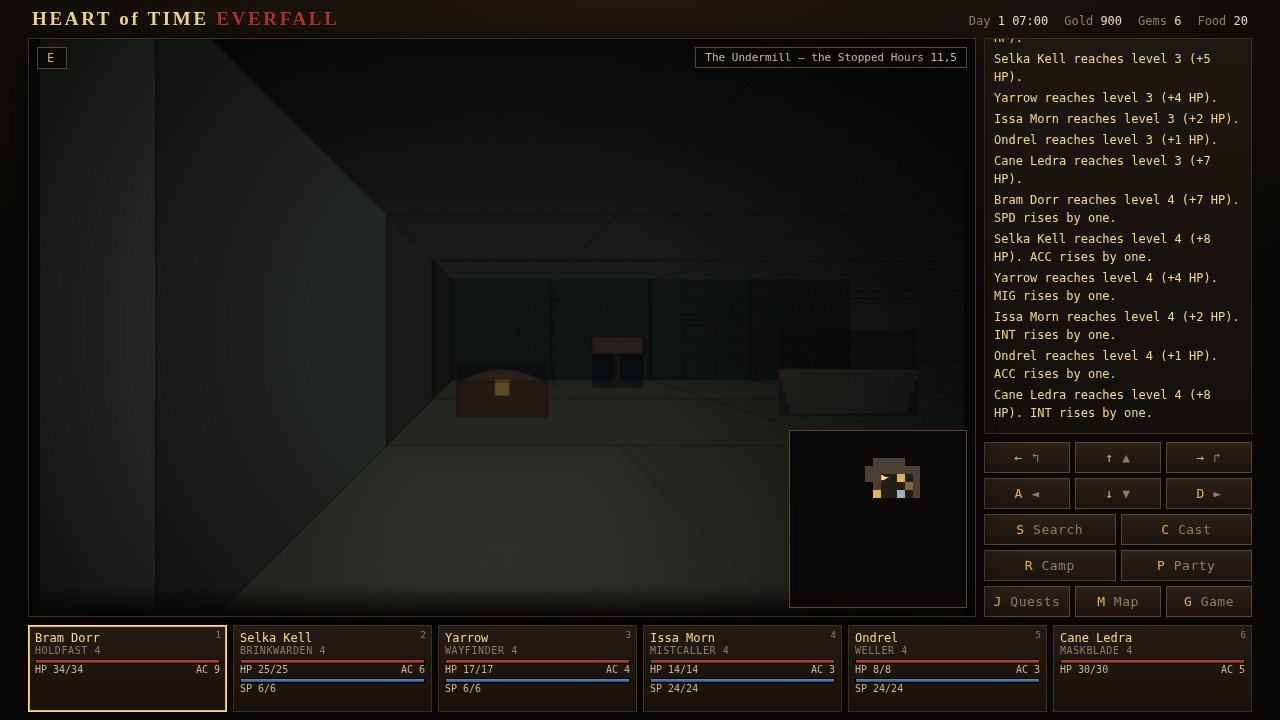
The dungeon in the image above is from Heart of Time: Everfall, almost fifty years after pedit5 sent one lone hero into a 30 by 30 maze. Browse the hub for more games and the classics behind them.
More from the blog
 Why are browser games silent until you click?Browsers block sound on a page until you interact with it, so a web game cannot play audio before your first click, tap or key press. Here is how the rule works and why it exists.
 What is procedural generation in games?Procedural generation means a game builds its levels, maps or worlds with rules and random numbers instead of storing each one made by hand. Here is how it works, what a seed is, how Rogue, Elite, Minecraft and No Man's Sky used it, and three browser games where you can see it.
 What is coyote time in games?Coyote time is a short grace period that lets you jump just after running off a ledge. Here is how it works, how long it lasts in Celeste's own code, the tricks that go with it, and why some platformers leave it out on purpose.