Blog ·
What is procedural generation in games?
Procedural generation means a game makes its content (levels, maps, caves, whole galaxies) by running a set of rules on numbers, instead of storing every piece a designer drew by hand. Give the rules the same starting number, called a seed, and you get the same world back; change the seed and you get a new one. That is how Rogue builds a fresh dungeon each game, how Elite fit 2,048 star systems onto a 1980s home computer, and how Minecraft and No Man's Sky offer more places than anyone could ever visit.
How does procedural generation work?
Every procedural world starts from two things: a recipe and a source of numbers.
- The numbers come from a pseudo-random number generator, a short formula that turns one number into a long stream of numbers that look random. They are not truly random: the same starting number, the seed, always produces the same stream.
- The recipe is the game's own rules for what those numbers mean: "if this value is high, put a mountain here", "carve a tunnel where these two values cross", "a room is between 4 and 9 squares wide".
Because the stream is repeatable, a game does not have to store the world it made. It stores the seed and rebuilds the world whenever it needs it. That is why procedural generation was first a way to save memory, and is now also a way to make something new every time you press start.
What is a seed in a game?
A seed is the number the whole world is grown from. The Minecraft Wiki's page on world seeds puts the rule plainly: on the same version of the game, "the same seed generates the same terrain every time". If you type a word instead of a number, Minecraft turns it into a number first. The same page notes that the promise breaks when the game's generator is updated, because new rules read the same numbers differently.
Seeds are why players can share a whole world by sharing one number.
Which games made procedural generation famous?
| Game | Year | What is generated | Source |
|---|---|---|---|
| Rogue | 1980 | A new dungeon every game | Spillhistorie.no interview |
| Elite | 1984 | 8 galaxies of 256 star systems each | Elite source code commentary |
| Minecraft | 2009 | An endless block world from one seed | Minecraft Wiki |
| No Man's Sky | 2016 | 18,446,744,073,709,551,616 possible planets | Guinness World Records |
Rogue. Glenn Wichman, who made Rogue with Michael Toy around 1980, told Spillhistorie.no that their idea was a game "where the computer itself created the environment you were exploring", so they "could create a game that could surprise even its creators". Every game built on that idea came to be called a roguelike; our post What is a roguelite? tells that story, and our Rogue page gathers the games it inspired.
Elite. David Braben and Ian Bell's space trading game came out in 1984, and the Science Museum Group describes how it fit "eight galaxies to explore, each containing 256 different planets" into a game smaller than a modern Word document: it used "mathematical algorithms to generate the details of each planet". Mark Moxon's annotated Elite source code shows the trick: every system's data comes from "a set of three 16-bit seed numbers", which the game twists over and over to produce the 2,048 sets of seeds for all eight galaxies. More on our Elite page.
Minecraft. Every new world starts from a seed, and the same seed gives the same mountains, caves and oceans on the same version, as the Minecraft Wiki explains. Our Minecraft page lists games built in its spirit.
No Man's Sky. Hello Games' universe holds 18,446,744,073,709,551,616 possible planets, "more than 18 quintillion", the figure Guinness World Records lists for the most explorable planets in a videogame, noting that the universe is "procedurally generated and every planet is unique". That number is exactly 2 to the power of 64, the count of values a 64-bit seed can hold. See our No Man's Sky page.
What is Perlin noise?
Pure random numbers make static, like a badly tuned TV. Real landscapes are smoother: a hill rises gently, then falls. Most generated terrain uses a kind of smooth randomness called noise, and the best known is Perlin noise, made by Ken Perlin. In 1997 he received a Technical Achievement Award from the Academy that hands out the Oscars, "for the development of Perlin Noise, a technique used to produce natural appearing textures on computer generated surfaces". His reference implementation of Improved Noise, the version from his SIGGRAPH 2002 paper, is still freely online.
Games usually stack several layers of noise: a slow, wide one for continents, a faster one for hills, a fast small one for bumps. Each layer has half the strength and twice the detail of the one before, and added together they look like ground.
Is procedural generation the same as random?
No. A random world is different every time with no way back. A procedural world is a function of its seed: the same seed and the same rules give the same result on any computer. That is what lets a game save a world in a few bytes, lets two players see the same cave, and lets a designer pick seeds that play well and ship those.
Most games also mix generated and hand-made parts. A designer might draw the town and let the rules make the wilderness, or hand-place the boss room inside a generated dungeon.
Can you see procedural generation in a browser game?
Yes. We read the code of three of our own games on Nov 13, 2026, and each one uses it differently:
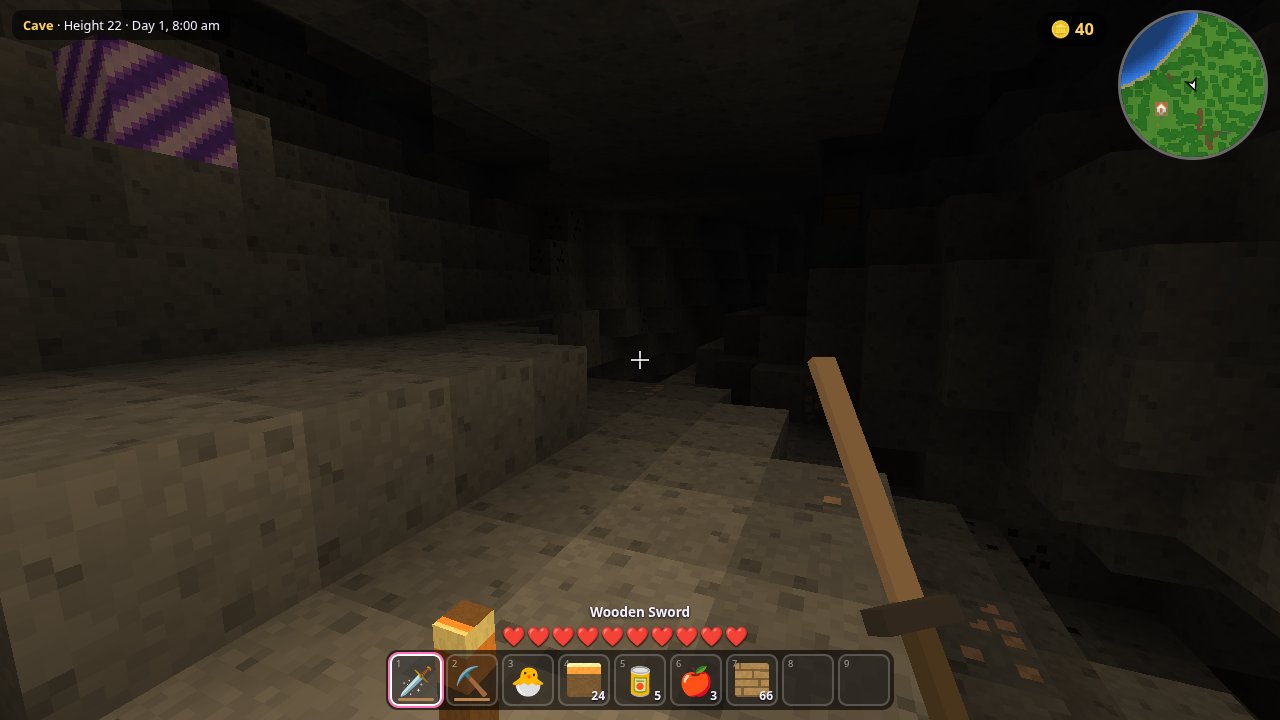
- Kyra Craft grows an endless block world from a seed it picks at random when you start a new game. Its terrain uses Perlin's improved noise, layered at several scales for continents, hills, lakes and mountains; its caves are carved where two noise bands cross, with a slower noise opening big caverns deep down; and its ores are scattered by depth, with diamonds only near the bottom of the world. Its save, kept in your browser, holds the seed plus the blocks you changed, not the whole world. The cave in the image above was carved this way.
- Tectonic, our Boulder Dash style cave digger, builds every cave from a seed made from the cave's number, so "cave 4 is the same cave 4 for everyone", as its code puts it. That keeps co-op races fair without storing any level files.
- Myth & Magic II, a party RPG, mixes both kinds: its town is drawn by hand, its wilderness map is grown from two noise maps (height makes mountains and lakes, moisture makes forests), and its six dungeon levels are generated from fixed seeds, so every player explores the same ones.
There is nothing to download: each one runs in your browser.
More from the blog
 Why are browser games silent until you click?Browsers block sound on a page until you interact with it, so a web game cannot play audio before your first click, tap or key press. Here is how the rule works and why it exists.
 What was the first computer RPG?The earliest computer role-playing game that still survives is pedit5, also called The Dungeon, written by Rusty Rutherford on the PLATO system at the University of Illinois in 1975. Here is how it played, the rival that followed it, the lost game called m199h, and where you can try them today.
 What is coyote time in games?Coyote time is a short grace period that lets you jump just after running off a ledge. Here is how it works, how long it lasts in Celeste's own code, the tricks that go with it, and why some platformers leave it out on purpose.